


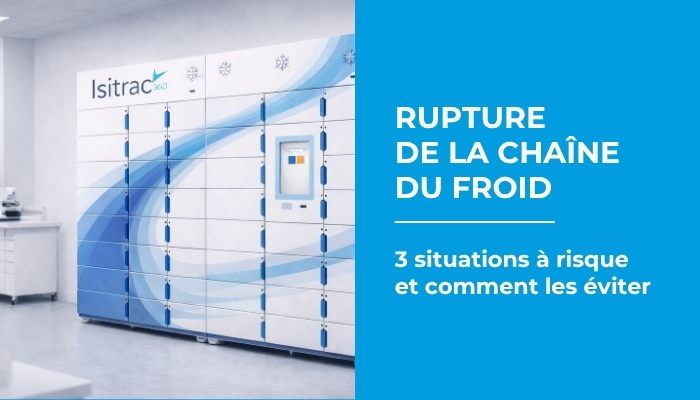
The cold chain doesn’t always break due to a failure. It breaks in everyday blind spots: a delivery received outside business hours, a transfer between departments without traceability, a shared storage unit with no access control. Situations that may seem routine — yet directly expose organizations to the requirements of GDP, GMP, and ISO standards.
1. Receiving Temperature-Sensitive Products Outside Business Hours
A delivery driver drops off a package containing temperature-sensitive products at reception at the end of the day. The responsible staff member is absent. The package remains at room temperature before being placed in cold storage—without anyone knowing exactly for how long.
This scenario is common. It is also difficult to justify in the event of an inspection.
Good Distribution Practices (GDP) and the recommendations of the National Order of Pharmacists require the immediate handling of temperature-sensitive healthcare products (TSP) upon receipt: time-stamped recording, identification of the receiver, and immediate placement in a qualified storage unit between +2°C and +8°C.
Without an autonomous reception system, this requirement simply cannot be met outside of operating hours.
Regulatory risk: lack of proof of temperature compliance at receipt — immediate GDP non-compliance in the event of an audit.
2. Inter-department transfers: when traceability disappears between two doors
A temperature-sensitive product moves from a logistics department to a care unit, or from a reception laboratory to an analytical unit. Between the two, there is a corridor, possibly a waiting period — and often no record at all.
It is precisely at this handover point that traceability most frequently breaks down. No one “owns” the product. If an issue arises, it becomes impossible to determine at which stage it occurred.
ISO 15189 (medical laboratories) and HAS guidelines require complete documentation of the chain of custody. The inability to reconstruct a product’s full history — including internal transfers — is a frequent cause of non-conformity during external assessments.
Regulatory risk: incomplete audit trail — direct impact on ISO 15189 accreditation and HAS quality compliance processes.
3. Uncontrolled access to a shared refrigerated storage unit
The service refrigerator is accessible to everyone, opened several times per hour, and shared between different types of products. Temperature excursions are frequent — and silent. They trigger no alarms and leave no visible trace.
Until the day of the audit.
Regulatory guidelines and Good Manufacturing Practices (GMP) require qualified storage units with restricted access and continuous temperature monitoring. A shared refrigerator without access control does not meet these requirements — even if temperatures appear to be within range.
Regulatory risk: questionable qualification of the storage unit, lack of access traceability, and non-compliance with professional guidelines and GMP requirements.
What these three situations have in common
They occur in well-structured organizations, with trained teams and established procedures. Cold chain failure is not the result of negligence — it stems from the inability of manual processes to automatically cover the most exposed transition points.
The most effective response is not to provide more training. It is to automate predictable failure points: secure autonomous reception, formalize inter-department handovers with time-stamped proof, and strictly control access to refrigerated storage units.
IsiLocker connected refrigerated unit: a solution designed for these three scenarios
Maintained between +2°C and +8°C and accessible via PIN code, QR code, or badge, the IsiLocker connected refrigerated unit from Isitec International secures the deposit and retrieval of temperature-sensitive products with full autonomy, 24/7.
Each operation is time-stamped and integrated into the Isitrac platform, creating a complete event log that can be used during audits. The solution directly addresses the three identified scenarios: autonomous reception, traceable inter-department handovers, and controlled access to the storage unit.