

Introduction — The PDA, a New Ally of Digital Traceability
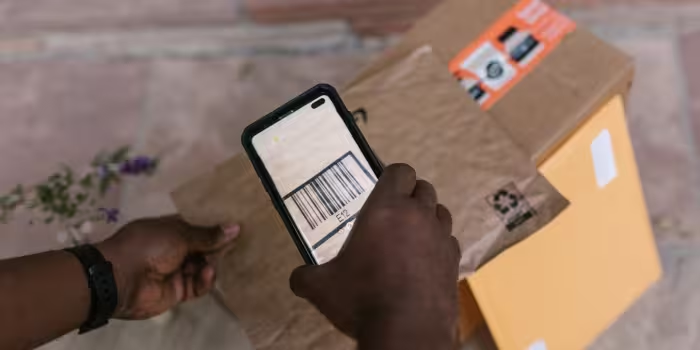
The modern PDA (Personal Digital Assistant) is far more than a simple mobile terminal. In internal logistics, it has become one of the cornerstones of digital traceability. These rugged devices, often running on Android, combine durability, barcode or QR code scanning, Wi-Fi/4G connectivity, and long battery life.
In the hands of receiving staff, IT technicians, or internal couriers, the PDA makes it possible to capture and track every step of a workflow: receipt, inspection, routing, delivery to the recipient, or logging in a connected locker.
Why has this tool become essential? Because internal workflows are becoming increasingly complex. Remote work, multiple sites, heightened security, GDPR compliance—these are all factors that demand precise, reliable, and real-time traceability. The PDA turns each operator into a field data sensor, ensuring a clear, time-stamped view of movements.
Connected to a traceability solution such as Isitrac or its new generation, Isitrac 360, it becomes an essential link in smooth internal logistics, with no re-entry of data and no loss of information.
From Scan to Proof: How the PDA Simplifies Traceability
The use of PDAs in internal logistics is based on a simple principle: scan, enrich, and prove.
Each scan links a unique identifier (barcode, QR code, registered item number) to a set of metadata: date, location, operator, object type, or recipient. This information automatically feeds the traceability system, triggers workflow steps, and sends notifications to the relevant employees.
Some typical use cases:
- Parcel or Mail Reception: Scanning upon receipt records the item, assigns an internal number, and notifies the recipient.
- Internal Distribution: Each delivery is confirmed via signature on the PDA or badge, ensuring proof of internal delivery.
- Management of Sensitive Items: For keys, badges, or IT equipment, each loan is tracked and monitored, with automatic alerts in case of overdue items.
- Connected Lockers: Outside of working hours or in a flex-office setup, deposits in lockers allow for autonomous and secure retrieval while maintaining complete traceability.
Solutions such as Isitrac Locker or IsiLocker Lite integrate seamlessly with these use cases, providing a continuous link between PDA scanning and physical storage. The collected data then feeds dashboards and performance indicators for logistics managers or administrative departments.
Benefits: Reliability, Responsiveness, and Satisfaction
The combined use of PDAs and a traceability solution brings tangible benefits across all levels of the organization:
- Zero loss, zero ambiguity: every flow is time-stamped, and every delivery is verified.
- Time savings: mobile entry eliminates double data entry and speeds up rounds.
- Real-time management: data is transmitted instantly, enabling analysis of volumes, delays, and anomalies.
- Easier compliance: record-keeping and audit exports simplify quality and safety inspections.
- Improved experience: reduced waiting times, greater autonomy, and better visibility for internal users.
- Cost optimization: fewer disputes, elimination of paper, and shared distribution through lockers.
In multi-site, hospital, or industrial environments, this connected approach provides a consolidated view of internal workflows and enables data-driven decision-making based on tangible information.
The Future of the PDA: Embedded Intelligence and Interoperability
PDAs are evolving toward a new generation,
With the help of OCR (Optical Character Recognition) and automatic carrier label reading, they can now identify a tracking number, service code, or site and detect inconsistencies before they turn into errors.
At Isitec, this innovation takes the form of the IA Scan module, integrated into Isitrac 360. It ensures reliable information capture while simplifying operators’ work.
Integration via API with information systems (ERP, ITSM, SSO, business tools) opens up new possibilities: automatic ticket creation, tracking of sensitive items, updating of reference databases, and more.
In the future, these tools will also be able to predict reception peaks, recommend route adjustments, and optimize the capacity of connected lockers. Traceability will no longer merely describe the past: it will help anticipate and guide decision-making.
Conclusion — The PDA, the Backbone of Modern Traceability
Today, the PDA has established itself as the reference tool for internal traceability. It connects field actions to strategic data, turning every scan into proof and every movement into useful information.
When paired with a flow management platform such as Isitrac or Isitrac 360, it contributes to building a connected, secure, and sustainable internal logistics system.
Adopting the PDA is therefore much more than a technological choice: it is a lever for reliability, responsiveness, and operational performance in support of both teams and users.